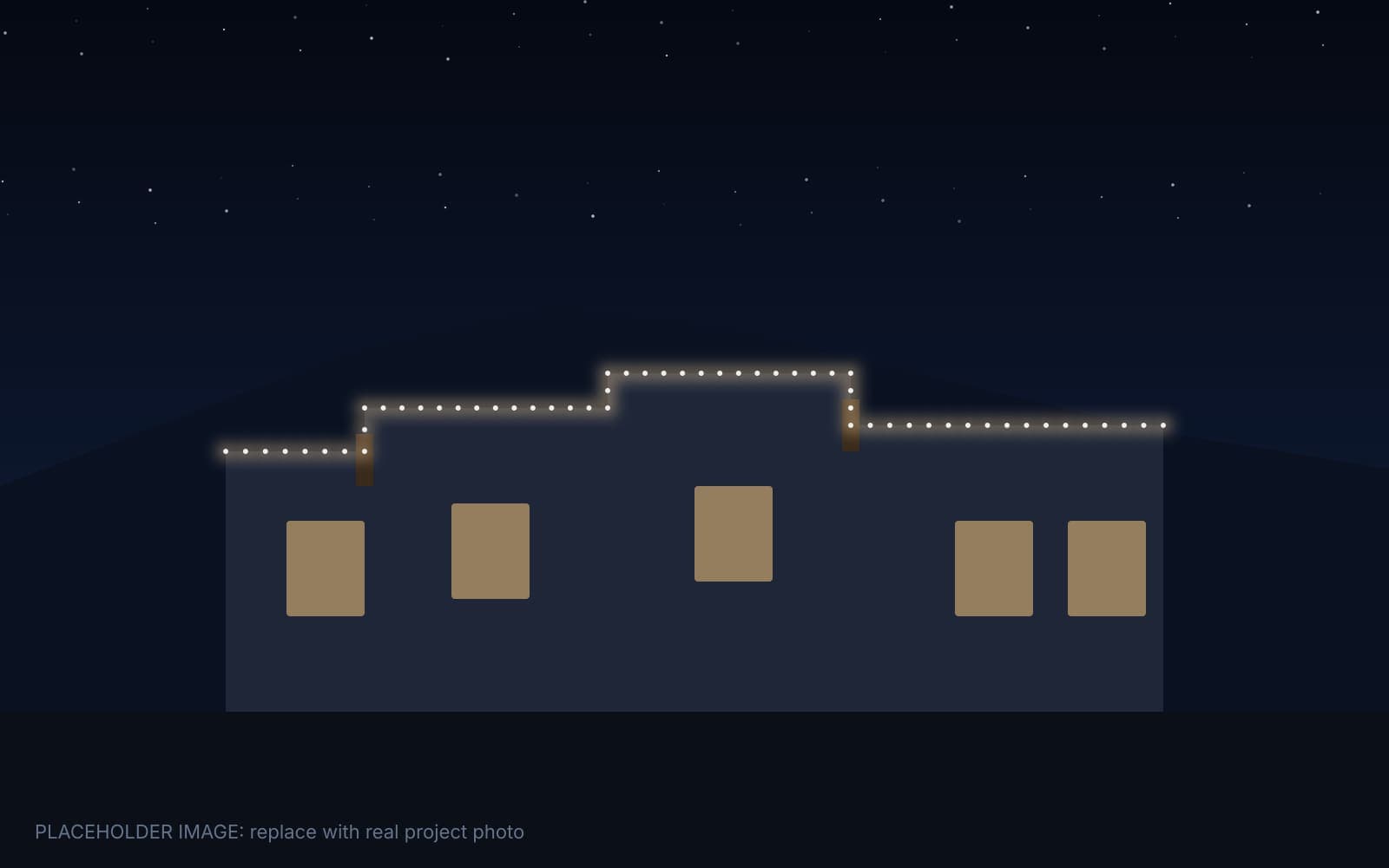
Drive through almost any part of Albuquerque and you will see flat roofs. Pueblo Revival homes with rounded parapets, Territorial homes with brick coping, mid-century ranch homes, and newer stucco builds with flat roof sections all share one thing: there is no traditional gutter line to clip lights to.
That leads to one of the most common questions we hear: can permanent lights actually go on a flat roof or parapet? The short answer is yes. The longer answer, and the reason the details matter, is what this post is about.
Why Flat Roofs Are Different
Most permanent lighting you see online is designed around a pitched roof. The track mounts under the eave or along the fascia board, where it is tucked away and protected. A flat roof with a parapet does not have that same eave, so the approach has to change.
Parapets are the short walls that extend above the roofline on many Southwestern homes. They are usually framed and finished with stucco, sometimes capped with metal flashing, brick or a smooth stucco cap. They are also part of what keeps water moving toward canales and off your roof. That means anything we attach to a parapet needs to respect the stucco finish and the roof's drainage.
Where the Lights Can Go
There are several placement options, and the right one depends on your home's style and what look you want.
Just Below the Parapet Cap
On many homes, the cleanest look is a track mounted just under the top edge of the parapet, facing outward. At night, the lights trace the silhouette of the house. During the day, a color-matched track is hard to spot against the stucco.
Along a Fascia or Trim Band
Some flat-roof homes, especially Territorial styles and certain ranch homes, have a fascia board, brick band or trim line near the top of the wall. That gives us a natural mounting surface that keeps the track tucked into an existing architectural line.
Under Portal and Ramada Edges
Many flat-roof homes have covered portals, ramadas or porches with their own beam or fascia line. These are excellent spots for lighting because they frame outdoor living areas and entries. They also tend to be partially sheltered from direct sun.
Stepped and Rounded Parapets
Pueblo Revival homes often have stepped parapets and soft, rounded corners. These shapes look great lit up, but they take more planning. We map the transitions so the lights follow the architecture smoothly instead of looking chopped up at every step.
Protecting Your Stucco and Your Roof
This is the part that matters most, and it is the reason a parapet install should be done with care.
Mounting into stucco. Stucco is a finish layer over the wall structure. Fasteners need to go through it properly and be sealed so water does not find a path behind the finish. Careless drilling can create cracks or leak points that show up months later.
Staying clear of drainage. We plan the run so the track and wiring do not interfere with canales, scuppers or the flow of water off the roof. Summer monsoon storms in Albuquerque can dump a lot of water in a short time, and that water needs a clear path.
Respecting the roof membrane. On flat roofs, we avoid penetrating the roofing membrane itself. Wire routing is planned along walls and through appropriate paths instead of across the roof surface.
Matching the finish. Track color is chosen to blend with your stucco or trim. Earth tones, tans, whites and darker browns are all common across the metro, and the goal is for the system to disappear in daylight.
Planning Power and Zones
Flat-roof homes often have long, continuous runs of parapet and several separate wall faces. That makes zone planning important. You might want the front parapet on one zone, the portal on another, and the back patio wall on a third. That way you can run warm white on the patio for a summer evening while the front shows colors for a holiday.
We also look at where power is available. On many homes there is a convenient outlet or junction point near the garage or under a portal. On others, a little more planning is needed. Either way, we sort that out during the site visit, before any work begins.
How It Handles New Mexico Weather
Parapets are fully exposed. There is no overhang shading them, so the track and lights face the full force of high-desert sun all day. Spring wind season sends dust and grit across the city, and summer monsoons bring heavy rain and sometimes hail.
The system is built for those conditions, with UV-resistant materials, sealed lighting components and a low-profile track that does not catch the wind. Freeze-thaw winter nights are also a factor, which is another reason careful sealing at each mounting point matters. If you want to dig deeper into weather durability, our post on sun, wind and monsoons covers it in more detail.
Common Questions About Parapet Lighting
Will I see the track during the day?
Very little. The track is low-profile and chosen to blend with your stucco or trim. Most visitors will not notice it unless you point it out.
Can I light just part of the house?
Yes. Some homeowners start with the front elevation or just the portal and add more later. Zones make it easy to expand.
Does it work for both holidays and everyday lighting?
Absolutely. Warm white works beautifully on adobe-toned stucco for everyday evenings and accent lighting. For Christmas Eve, an amber glow pairs naturally with luminarias lining a parapet or walkway. Then you can switch to Zia red and yellow, Lobos cherry and silver, or Halloween orange and purple from the app.
What about homes that have both flat and pitched sections?
Plenty of Albuquerque homes mix a flat-roof section with a pitched garage or addition. We design the layout so both sections read as one continuous outline at night, even though the mounting method changes between them.
Is a Parapet Home a Good Fit for Permanent Lighting?
In our view, flat-roof and parapet homes are some of the best-looking homes to light. The clean horizontal lines of Pueblo Revival and Territorial architecture create a striking outline after dark, especially against a clear desert night sky.
The key is choosing an installer who understands stucco, drainage and Southwestern rooflines. You can read more about our approach on the parapet and flat roof lighting page, including the placements we use most often.
We install on flat-roof homes throughout the metro, from Old Town and Nob Hill to the Northeast Heights and the West Side. See the neighborhoods we serve on our Albuquerque service area page.
Curious what your parapet would look like lit up? Get a free quote and our local crew will walk your home, talk through mounting options and lay out a design that respects your stucco and your roof.